OpenResty/LuaJIT - The fastest backend technology ever exists.
1. LuaJIT is bridge between internal Nginx structures and allow directly manupulate Nging features.
In this year I'm faced in real project with fantestic technology - LuaJIT compiler what allow scripting internal Nginx features:
| Feature | How OpenResty Uses It |
|---|---|
| Event-Driven Model | Lua runs asynchronously (no blocking I/O). |
| Shared Memory Zones | Lua scripts share data across workers (lua_shared_dict). |
| Subrequests | Lua can spawn internal HTTP requests (ngx.location.capture). |
| TCP/UDP Stream | Lua handles non-HTTP traffic (e.g., proxies, game servers). |
Speed of this technology is fantastic, because this is C-brigge directly embedded to handle Nginx hook and Nginx features.
| Nginx Phase | OpenResty Lua Hook | What You Can Do |
|---|---|---|
| Rewrite Phase | rewrite_by_lua* | Modify URLs, redirects (before routing). |
| Access Phase | access_by_lua* | Authentication, rate limiting. |
| Content Phase | content_by_lua* | Generate dynamic responses (bypass Nginx's static handler). |
| Header Filter Phase | header_filter_by_lua* | Modify HTTP headers before sending. |
| Body Filter Phase | body_filter_by_lua* | Modify response body (e.g., HTML sanitization). |
| Log Phase | log_by_lua* | Custom logging (e.g., analytics). |
1:
2: -- Shared memory across all workers
3: http {
4: lua_shared_dict my_cache 10m;
5: server {
6: location /get {
7: content_by_lua_block {
8: local cache = ngx.shared.my_cache
9: cache:set("key", "value", 60) -- Set with TTL
10: ngx.say(cache:get("key")) -- Get value
11: }
12: }
13: }
14: }
15:
1:
2: -- Non-Blocking Database Query
3: location /user {
4: content_by_lua_block {
5: local mysql = require "resty.mysql"
6: local db = mysql:new()
7: db:connect({ host = "127.0.0.1", user = "root" })
8: local res = db:query("SELECT * FROM users") -- Async!
9: ngx.say(res[1].username)
10: }
11: }
12:
1:
2: -- conditionally transform data before Nginx’s C core sees it
3: location /api {
4: access_by_lua_block {
5: if ngx.var.arg_token ~= "secret" then
6: ngx.exit(403) -- Reject before C code runs
7: end
8: }
9: proxy_pass http://backend; -- Nginx C core takes over
10: }
11:
Lua language allow diredctly use C-functions exposed by Nginx.
1:
2: // Nginx C module exposing a function to Lua
3: static ngx_int_t ngx_http_lua_hello(ngx_http_request_t *r) {
4: ngx_http_lua_ctx_t *ctx = ngx_http_get_module_ctx(r, ngx_http_lua_module);
5: lua_pushstring(ctx->lua, "Hello from C!");
6: return NGX_OK;
7: }
8:
2. Fantesctic speed.
This is about speed (LUA at least 10 times faster than Javascript !!! and twice faster than C++ !!!):
| Backend | Avg. RPS (Plain Text) | Latency (ms) | Key Strengths |
|---|---|---|---|
| ⚡ C (Manual) | 200K - 300K+ | 0.1 - 1ms | Direct hardware access, no overhead |
| 🔥 OpenResty (Lua) | 150K - 250K+ | 0.5 - 2ms | Nginx event loop + LuaJIT (C-like speed) |
| 🚀 Rust (Actix/Axum) | 120K - 200K+ | 1 - 3ms | Zero-cost abstractions, no GC pauses |
| 🦀 C++ (Boost.Beast) | 100K - 180K+ | 1 - 4ms | High performance with OOP features |
| 🚙 Go (Gin/Fiber) | 80K - 150K+ | 2 - 5ms | Goroutines (easy concurrency), fast GC |
| 🟪 C# (ASP.NET Core) | 50K - 100K+ | 3 - 10ms | Great for enterprise, strong ecosystem |
| 🐘 PHP (Laravel/Swoole) | 30K - 70K | 5 - 15ms | Web-first design, huge CMS ecosystem |
| 🐢 Node.js (Express) | 10K - 30K | 5 - 20ms | Single-threaded (bottlenecked by JS event loop) |
| 💩 Python (Django/Flask) | 5K - 20K | 10 - 50ms | Developer productivity, data science |
3. Term.
| Feature | Lua (Standard) | LuaJIT (FFI) | OpenResty (Nginx + LuaJIT) |
|---|---|---|---|
| Type | Language | Lua compiler/runtime | Nginx + LuaJIT platform |
| Speed | Slow | Very fast JIT | Extremely fast Nginx + JIT |
| Use Case | General scripting | High-perf Lua | Web backends, proxies |
| Ecosystem | Small | Small (but fast) | Rich Nginx modules + Lua |
| C Integration | Lua C API (manual bindings) | Direct FFI (no bindings) | FFI + Nginx C modules |
| Performance | Slow (Lua ↔ C marshaling) | Near-native speed | Near-native speed |
| Use Case | Embedding Lua in C apps | High-perf Lua+C apps | Web/API servers with C extensions |
4. Lua is extremely easy language.
| Language | Difficulty | Why? | Best For |
|---|---|---|---|
| Lua | ⭐️ (Very Easy) | Tiny syntax, no OOP, minimal stdlib. Feels like "shell scripting." | Embedding (games, Nginx), quick scripts |
| VB.NET | ⭐️ (Very Easy) | Simple English-like syntax, verbose and understandable | Web backend, Windows and Linux apps, any business applications |
| Python | ⭐️⭐️ (Easy) | Readable, huge stdlib, but indentation-sensitive | Beginners, data science, automation |
| PHP | ⭐️⭐️⭐️ (Medium) | Simple to start but inconsistent standard library, many legacy quirks | Web development, CMS systems (WordPress) |
| C# | ⭐️⭐️⭐️ (Medium) | Well-structured but requires understanding of .NET ecosystem | Enterprise applications, Windows development, games (Unity) |
| Go | ⭐️⭐️⭐️ (Medium) | Simple syntax but rigid (no generics early), manual error handling | Microservices, CLI tools, cloud applications |
| JavaScript | ⭐️⭐️⭐️⭐️ (Medium-Hard) | Weird quirks (this, == vs ===), async/await, ecosystem fatigue | Web frontend/backend (Node.js) |
| Java | ⭐️⭐️⭐️⭐️ (Medium-Hard) | Verbose syntax, complex build systems, enterprise patterns | Enterprise systems, Android apps (historically) |
| C++ | ⭐️⭐️⭐️⭐️ (Hard) | Manual memory management, complex standard library, multiple paradigms | Game engines, high-performance systems |
| Rust | ⭐️⭐️⭐️⭐️⭐️ (Very Hard) | Ownership/borrowing, lifetimes, strict compiler | High-perf systems, safety-critical apps |
| Language | Pros | Cons (Compared to Lua) | Unique Aspects | Main Challenges |
|---|---|---|---|---|
| Lua |
|
|
|
|
| VB.NET |
|
|
|
|
| Python |
|
|
|
|
| PHP |
|
|
|
|
| C# |
|
|
|
|
| Go |
|
|
|
|
| JavaScript |
|
|
|
|
| Rust |
|
|
|
|
5. Lua syntax.
And this is syntax of LUA language:
| Lua Syntax | VB.NET Equivalent |
|---|---|
| Variables and Assignment | |
| x = 10 | Dim x As Integer = 10 |
| name = "John" | Dim name As String = "John" |
| a, b = 1, 2 -- Multiple assignment | Dim a As Integer = 1, b As Integer = 2 |
| Control Structures | |
| if x > 10 then print("Big") end |
If x > 10 Then Console.WriteLine("Big") End If |
| if x > 10 then print("Big") else print("Small") end |
If x > 10 Then Console.WriteLine("Big") Else Console.WriteLine("Small") End If |
| for i = 1, 10 do print(i) end |
For i As Integer = 1 To 10 Console.WriteLine(i) Next |
| while x < 10 do x = x + 1 end |
While x < 10 x += 1 End While |
| repeat x = x - 1 until x <= 0 |
Do x -= 1 Loop Until x <= 0 |
| Functions | |
| function add(a, b) return a + b end |
Function Add(a As Integer, b As Integer) As Integer Return a + b End Function |
| local function foo() -- local function end |
Private Sub Foo() ' private method End Sub |
| Tables (Lua) vs Collections (VB.NET) | |
| t = {1, 2, 3} -- Array-like table | Dim list As New List(Of Integer) From {1, 2, 3} |
| t = {name="John", age=30} -- Dictionary-like table | Dim dict As New Dictionary(Of String, Object) From {{"name", "John"}, {"age", 30}} |
| print(t[1]) -- Access array element (1-based) | Console.WriteLine(list(0)) ' 0-based index |
| print(t.name) -- Access table field | Console.WriteLine(dict("name")) |
| Error Handling | |
| local ok, err = pcall(function() error("oops") end) if not ok then print(err) end |
Try Throw New Exception("oops") Catch ex As Exception Console.WriteLine(ex.Message) End Try |
| Object-Oriented Programming | |
| -- Lua OOP using tables Person = {name="Unknown"} function Person:new(o) o = o or {} setmetatable(o, self) self.__index = self return o end |
' Native VB.NET class Public Class Person Public Property Name As String = "Unknown" Public Sub New() End Sub End Class |
| p = Person:new({name="John"}) print(p.name) |
Dim p As New Person With {.Name = "John"} Console.WriteLine(p.Name) |
6. My real project.
So, I'm happy tu use this language in practice to made refactoring some project made on this technology.
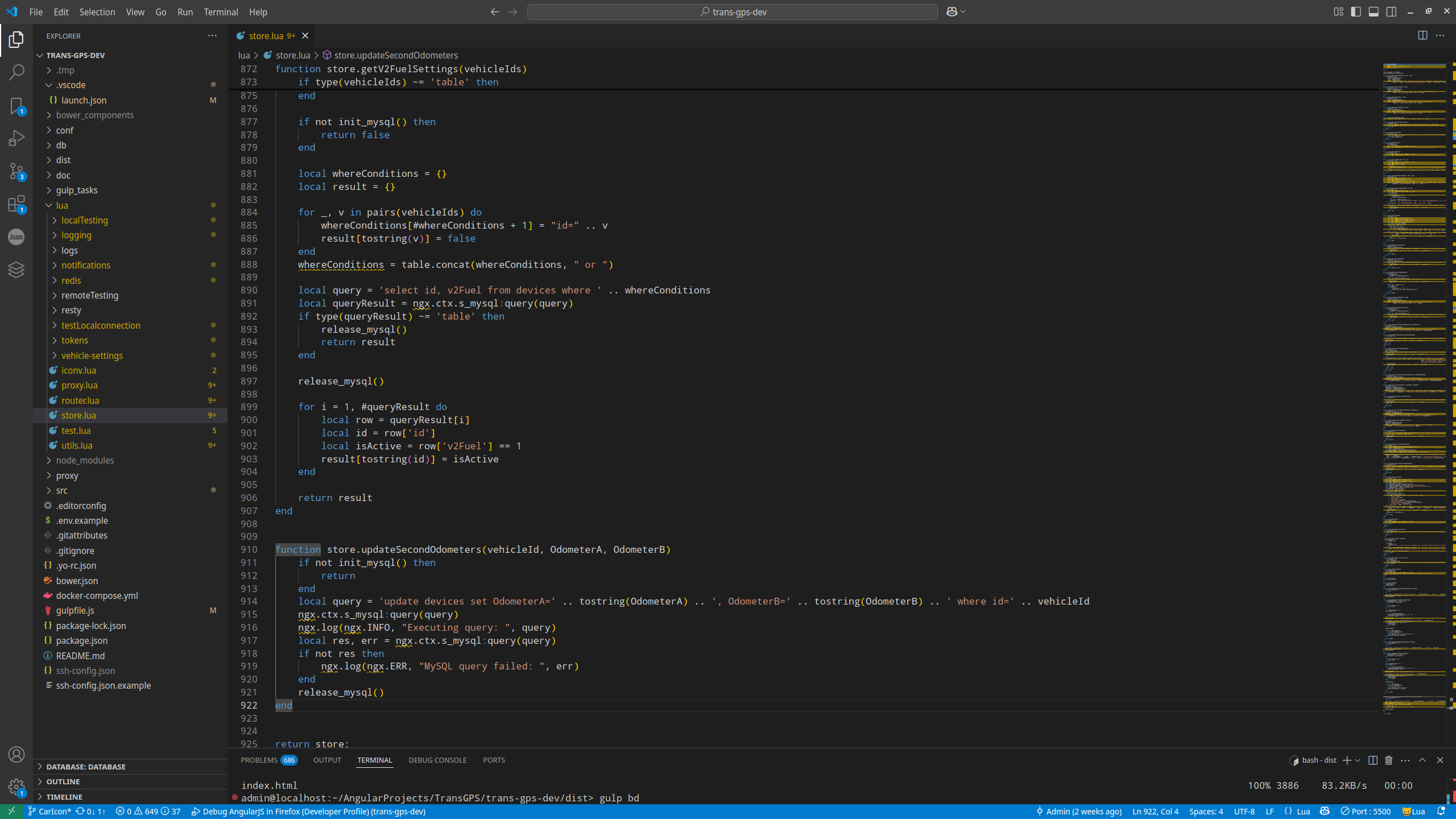
More details and continue in page Key points to working with Nginx LUA scripts - location of Nginx config and log, LuaJIT version, cache LUA scripts, debug and logging LUA, testing with CURL, LUA modules scope, LUA packages, Table type variable, working with Redis and MySQL.
Linux context:
 )
)
|
|